If you are dreaming about an Aga but are not sure whether a 2 oven Aga will be big enough for your home, this guide is for you.
On this page we explain in plain English what a 2 oven Aga is, which ovens and hotplates you get, how it cooks in real life, how much space it needs, and who it suits best. We will also point you to detailed guides on temperatures, dimensions, running costs and prices, so you can decide with confidence whether a 2 oven Aga is the right choice for your kitchen.
At John Wray Range Cookers we specialise in reconditioned and converted Aga cookers, so everything below is based on how people actually live and cook with them, not just brochure theory.
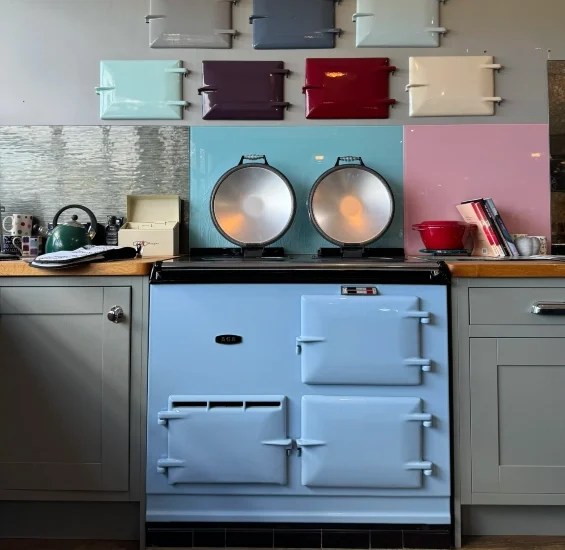
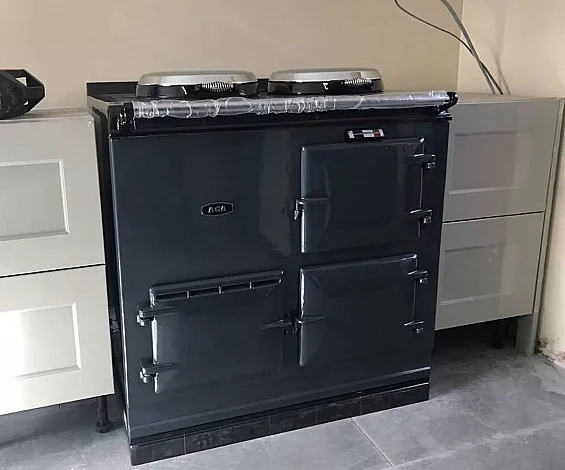
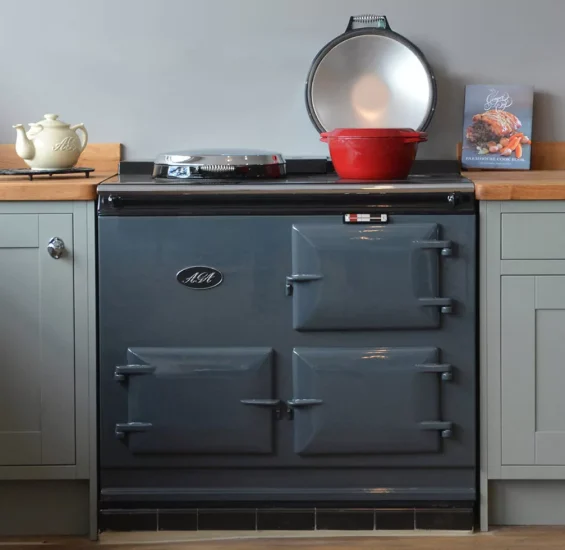
A 2 oven Aga is the classic starting point in the Aga family. It is a cast iron heat-storage cooker with:
Two ovens
Two hotplates under the top lids
A heavy enamelled top that stays warm and gives off gentle background heat
On a traditional 2 oven Aga, the two doors on the front are:
The top oven, which is your main roasting and baking oven
The lower oven, which is your simmering and slow-cooking oven
On some models there is also a third door or panel. This is usually where the controls sit, not an extra oven. That can be confusing when you look at photos online, so it is worth spelling out clearly.
The idea is simple. The Aga stores heat in its cast-iron body. You then use different zones, shelves and oven positions to get the right temperature for roasting, baking, simmering and keeping food warm.
A 2 oven Aga is more flexible than it looks. Even though there are only two ovens, you have several cooking zones once you understand how they work.
The top oven on a 2 oven Aga is usually called the roasting oven. It is the hottest oven and is used for:
Traditional Sunday roasts
Pies and pastries
Gratins and lasagnes
Crispy roast potatoes and vegetables
Fast baked items such as pizzas and flatbreads
Heat is strongest towards the top and a little gentler lower down, so you can move trays up or down to fine-tune how fast things cook.
With the help of a cold plain shelf, many owners also use the roasting oven for baking cakes and biscuits. The cold shelf deflects direct heat from the top and creates a softer baking zone inside the same oven.
The lower oven is the simmering oven. It runs at a gentler temperature and is perfect for:
Slow-cooked stews and casseroles
Braising meat until it is tender
Long-cooked soups and stocks
Meringues
Keeping plates and food warm before serving
This is the oven that lets you put something in earlier in the day and come back later to a soft, tender result without worrying about it burning.
Under the two lids on top of a 2 oven Aga you will usually find:
A boiling plate, which is very hot and used for fast boiling, searing, stir-fries and bringing pans quickly up to temperature
A simmering plate, which is gentler and used for sauces, porridge, scrambled eggs and gentle frying
You control the heat by moving pans between the two plates, rather than turning individual gas burners up and down. Once you get used to it, this feels very natural and easy.
Every Aga is a little different. 2 oven Aga temperatures depend on the fuel type, the controls (traditional, factory electric or converted) and how the cooker has been set up.
With an Aga you normally cook by position and zone, not by a precise number on a dial. The top of the roasting oven is the hottest part, lower shelves are gentler, and the simmering oven and hotplates give you softer, long-cook heat.
On a classic always-on 2 oven Aga:
The roasting oven behaves like a hot conventional oven, broadly in the same territory as a low-to-mid 200s °C setting near the top, with the middle and lower shelves running cooler.
The simmering oven behaves like a very low oven, ideal for gentle slow cooking, meringues and keeping food warm.
The boiling plate is comparable to a powerful hob on full, used for fast boiling, searing and getting pans up to temperature quickly.
The simmering plate gives a gentle hob heat for sauces, porridge, scrambled eggs and long simmering.
Exact figures vary from cooker to cooker, which is why experienced owners talk about “top of the roasting oven” or “bottom of the simmering oven” rather than chasing a specific number.
For a deeper explanation of oven zones, shelf positions and how to translate recipes, see our main Aga oven temperature guide.
When a 2 oven Aga is converted to a modern electric system such as ElectricKit Advanced or the eControl Series X-Squared, you still get the familiar Aga layout, but with digital control over the heat.
In practice that means:
You choose modes or target temperatures (for example Roast, Bake, Simmer or a specific °C), and the controller brings each oven or hotplate up to that level and holds it there.
The top oven remains your roasting / main baking oven and the lower oven your long, gentle cooking and warming oven – you just have more control over how hot each one runs and when.
The hotplates are set up to behave like a traditional “boiling” plate and “simmering” plate, but you can turn them up, down or off completely instead of them sitting at one fixed heat all day.
To compare the different systems and choose the right electric conversion for your Aga, see our Aga electric conversion page. For typical budgets and price bands, take a look at our Aga electric conversion cost page.
A 2 oven Aga is the most compact traditional Aga and usually works best in smaller or narrower kitchens. It will typically sit neatly on a standard chimney breast or between normal kitchen units without overwhelming the room.
In most cases you only need to check:
The width of the alcove or straight run where the cooker will sit
That there is enough depth so it does not stick out awkwardly
That doors, drawers and walkways still open comfortably around it
Clearances and exact measurements depend on the model and fuel or conversion system. All of the detailed figures – widths, heights, depths, lid clearances and suggested recess sizes – are set out on our dedicated Aga dimensions page.
If you are unsure, measure your space, compare it with the figures there, and then send us your measurements and a couple of photos so we can confirm whether a 2 oven Aga will fit comfortably.
You can find 2 oven Agas in several fuel and control options, especially on the reconditioned market.
Common options include:
Older oil-fired or gas-fired 2 oven Agas that run as traditional heat-storage cookers
Factory electric 2 oven Agas that retain the classic look but use electric elements
Reconditioned Agas converted to modern electric systems with individual zone control
Modern electric and conversion systems can allow:
Faster warm-up and cool-down
Separate control of ovens and hotplates
Programmable timers
The ability to reduce background heat in summer
Potential running-cost savings compared with an older oil or gas model if you do not run the cooker 24 hours a day
If you already own a tired or older 2 oven Aga, you do not always have to replace it. In many cases we can strip it down, re-enamel the panels, renew worn parts and rebuild it so it looks and behaves like a new cooker. You can read more about what is involved on our Aga refurbishment page, and if you are comparing refurbishment with replacing the cooker, our Aga refurbishment cost guide explains typical costs and what is included.
If you are mainly concerned about ongoing bills rather than appearance, our Aga running costs guide explains how different fuel types and modern electric conversion systems compare in day-to-day use.
A 2 oven Aga is the simplest traditional layout. You have:
A roasting oven, which also acts as your main baking oven
A simmering oven for slow cooking and keeping food warm
Plus the two hotplates on top
Baking on a 2 oven Aga is done in the roasting oven, usually with a cold plain shelf to soften the heat and create a suitable baking zone. Many owners are very happy with this once they understand how to use the shelves and the cold plain shelf properly.
A 3 oven Aga adds a separate baking oven between the roasting and simmering ovens, so you have three different oven temperatures available at once. This suits people who bake frequently or who often have several dishes in the oven at different temperatures.
A 2 oven Aga is often the better choice if:
Your kitchen is smaller or more restricted for space
You prefer a simpler layout with fewer ovens to manage
You do not bake large batches regularly and are comfortable using the cold plain shelf for the baking you do
You want the look and feel of an Aga with the most compact traditional configuration
If, after living with a 2 oven Aga, you decide you would like the extra flexibility of a separate baking oven, you can always consider moving up to a 3 oven model in the future. For a broader overview of all the main Aga sizes, see our Which Aga cooker should you choose guide.
A 2 oven Aga is usually perfect for smaller households and most families up to around four people, as long as you plan your cooking and use both ovens and the hotplates well.
A 2 oven Aga is often the best choice when:
Your kitchen is fairly compact or you have a narrow chimney breast
You want the look and feel of a traditional Aga without the width of a 4 or 5 oven model
You like simple controls but still want to roast, bake, simmer and slow cook
You prefer a slightly lighter background heat, or you are planning an electric conversion with more control
You mainly cook for a small to medium household, with occasional larger gatherings
If several of these points sound like you, there is a very good chance that a 2 oven Aga will do everything you need.
Request a callback and we’ll give you straightforward, no-obligation advice.
Swale Lodge, Scorton Road, Brompton on Swale, Richmond, North Yorkshire, DL10 7EQ
© 2025 - John Wray Range Cookers is a trading name of John Wray Country Stoves Ltd | All rights reserved.
John Wray Country Stoves Ltd is an independent re-seller and is not authorised by or affiliated with Aga Rangemaster Ltd. “AGA” is a registered trademark of Aga Rangemaster Ltd.